BUSHFIRES. Horror hits Victoria. Jan 31 1962. A saga of death, destruction, and driving courage. Dandenong fires were normal summer news when I was a kid growing up in Melbourne back then.
BUSHFIRES (1962, January 31). The Australian Women’s Weekly (1933 – 1982), p. 3. Retrieved January 8, 2020, fromhttps://trove.nla.gov.au/newspaper/article/51193494?searchTerm=dandenongs%20bushfires&searchLimits=#
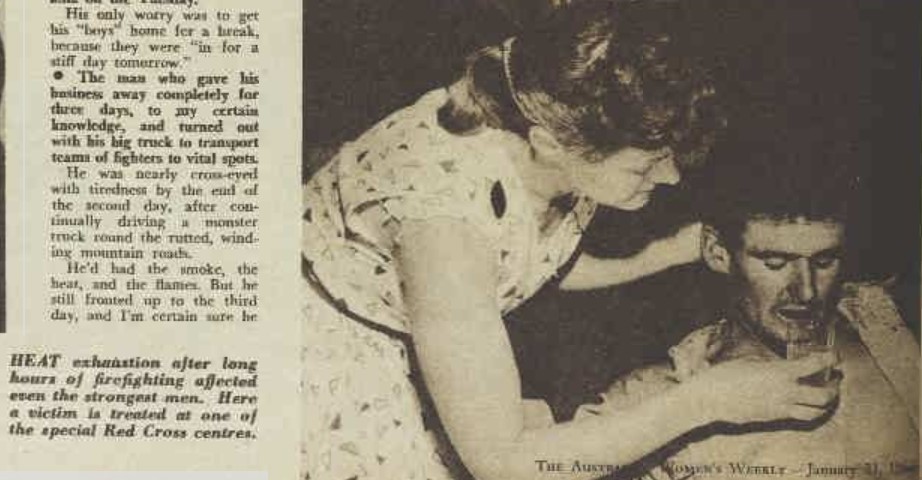
HEAT exhaustion after long
hours of firefighting affected
even the strongest men. Here
a victim is treated at one of
the special Red Cross centres.
A middle-aged woman walked slowly out of the Progress Hall at The Basin, where she’d been toiling steadily for 18 hours caring for the firefighters back for a breather after struggling for hours on end against the engulfing flames in the Dandenongs during Victoria’s most catastrophic bushfires since “Black Friday,” January 13, 1939.
She gazed fixedly at the huge black column of smoke spiralling in a great gusty wave from the tall timber high on the hill behind the hall. “It’s Tobruk Road,” called one of the firefighters directing a truckload of men and boys to the fresh outbreak.
The woman walked quietly back into the hall to carry on with her job without a backward glance at the terrifying volume of smoke.
“I thought it was,” she said. “Yes, that’s where I live,” she replied to an inquirer.
That one vignette tells the whole story of the courage and selflessness among the thousands of men, women, and children who fought Victoria’s bushfire battle for days on end in raging heat and violent winds.
By FREDA IRVING
THERE were the volunteer firefighters coming into control points- grimy, sweaty, eyes red-
rimmed, near collapse from heat exhaustion, but still bracing themselves to carry on after a brief breather.
Some were snake-bitten, some were burnt.
They were out on their feet, but they wouldn’t lie down.
Thousands of them came from all over the place to join in the fight.
The three young men returning from a holiday down Phillip Bay helped fight a fire at Drouin on the way home, saw the glow in the sky over the Dandenongs, went home for a couple of hours’ sleep, and then drove on to the nearest check-point.
They fought the fire all night and then left in time to get to work in Melbourne at nine.
They were back the next night to fight on, and the next.
Long ordeals
The youthful Country Fire Authority officer who’d started fighting on the Sunday night and was still fighting on at 2a.m. on the Tuesday.
His only worry was to get his “boys” home for a break, because they were “in for a stiff day tomorrow.”
The man who gave his business away completely for three days, to my certain knowledge, and turned out with his big truck to transport teams of fighters to vital spots.
He was nearly cross-eyed with tiredness by the end of the second day, after continually driving a monster truck round the rutted, winding mountain roads.
He’d had the smoke, the heat, and the flames. But he still fronted up to the third day, and I’m certain sure he would have gone on fronting till the danger was past.
The imperturbable policemen and Country Fire Authority officers who directed the teams of attacking forces and courteously but firmly blocked the thoughtless, sense less rubbernecks from choking vital roads.
Believe it or not, there were hundreds of them trying to get as close as they could for a grandstand view of other people’s tragedy and not lifting a finger to help.
They didn’t get far.
The women in the fire-fight were as grand as the men. Perhaps even grander, for they had none of the excitement of beating something back, the exhilaration of saving somebody’s home, the
spur of constant danger.
For them it was the never ending behind – the – scenes monotony of cutting sandwiches, pouring drinks, giving first-aid, cooking food; the continual nerve strain of worrying how their menfolk were faring in the fight, of comforting the homeless. And for some there was the
added constant fear of whether they themselves would have a home to go to when they finished their round – the – clock stint in stiflingly hot halls.
A grand job Between them all, these front – line and behind – the – scenes fighters – and the big
firms who helped by lending equipment – co-operated in saving countless homes and preventing what could have been a greater toll of human life.
When the Great Divide and the Dandenongs looked ablaze from end to end, with the flames throwing a great canopy of crimson in the sky, the amazing thing was that ANY houses were saved and that numberless lives weren’t lost.
“It was a miracle that more houses didn’t go,” a C.F.A. officer told me.
“Time and time again we hadn’t a hope of saving a house, and then suddenly there’d be a change of wind and all was well.”
But even so there were nearly 200 families for whom, between Sunday and Tuesday night, there was no miracle.
They were the ones who lost their homes and all their possessions. People like the painter and
decorator from Essex, Eng- land, who came to Australia with his family of four in 1956 and whose house (half paid for) has been left a shell by the flames.
Now he, his wife, their family, and his wife’s mother are left with only the clothes they were wearing at the time the 40ft- to 50ft–tall flames swept through Kalorama.
But they’ve still got their car in which they escaped, their son’s cat, Smokey, and all the hope and determination in the world.
Still smiling
“We’ll get going again – somehow,” said this game pair of parents with determined grins.
Somehow , all of them brought vividly to mind the Battle of Britain types-of World War II
They should have been beaten. Sometimes they were beaten, but they’d never admit it, and so they weren’t. That and the mass mateship which came out of the fires are two memories as
bright as the flames which, welded them.
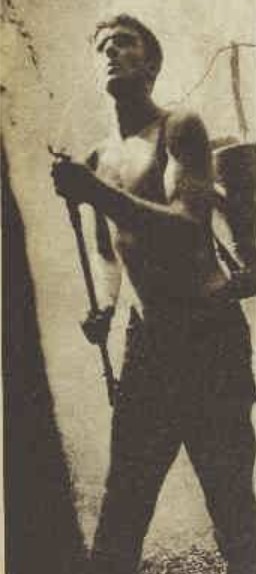
REGARDLESS OF DANGER, a young
firefighter in the Dandenongs helps in
the struggle to save a nursery threat-
ened by the relentless flames, which at
times raced at 40 miles an hour.