NSW faces the worst bushfires ever. 24 Sep 1980 ‘WE’RE SITTING ON A POWDER KEG. Spring has just started, yet already the State is experiencing its first bushfires.
NSW faces the worst bushfires ever ‘WE’RE SITTING ON A POWDER KEG’ (1980, September 24). The Australian Women’s Weekly (1933 – 1982), p. 2. Retrieved January 11, 2020, fromhttps://trove.nla.gov.au/newspaper/article/47229140/4877346#
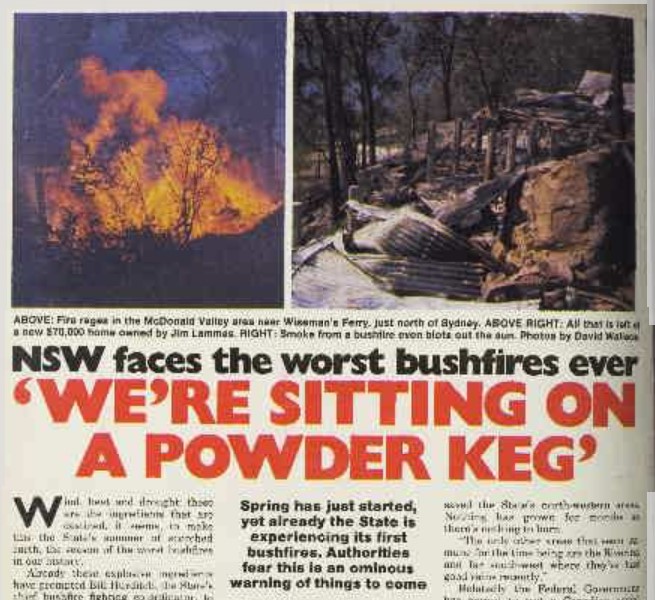
Wind, heat and drought: these are the ingredients that are destined, it seems, to make this the State’s summer of scorched earth, the season of the worst bushfires in our history.
Already these explosive ingredients have prompted Bill Hurditch, the State’s chief bushfire fighting co-ordinator, to declare: “Most of NSW is sitting on a powder keg.”
It is a powder keg almost certain to go off.
Along the coastal strip from Queensland to the Victorian border more than 300 fires were burning when Mr Hurditch tried to make an aerial survey last week.
He flew north from Sydney but could get no further than Port Macquarie.
Thick plumes of smoke brought visibility down to little more than one kilometre.
Light aircraft could not get off the ground to plot the direction of the fires being pushed by the “Big Blow” closer and closer to houses, crops, stock and populous towns.
At Wiseman’s Ferry, on the Hawkesbury River, just north of Sydney, teacher Jim Lammas tasted early the bitter pill that could be in store for hundreds, if not thousands, of other Austra- lians in the months to come.
His new $70,000 house fell prey to the hungry flames. In half an hour his house of dreams and everything in it were devoured and left like charred and chewed over bones.
There was nothing to salvage no kitchenware, precious possessions. Not even a child’s toy.
Already in most coastal areas the bushfire danger period has been brought forward an unprecedented seven weeks. Bill Hurditch explains why:
“Where there is timber there is almost certainly going to be fire.”
“The moisture content of potential fuels is so low because of the drought that when fires break out they spread like plague. It’s almost impossible to contain them, let alone put them out.
“Strangely, the drought has probably saved the State’s north-western areas. Nothing has grown for months so there’s nothing to burn.
“The only other areas that seem immune for the time being are the Riverina and far south-west where they’ve had good rains recently.”
Belatedly the Federal Government has agreed to test a Canadian aerial water bombing method of fighting bushfires in NSW.
This involves scooping large quantities of water from lakes, rivers or the sea and dumping it, more than six tonnes at a time, on spot fires ahead of the main fronts. It is argued that this
would prevent the quick spread of conflagrations.
The tests, however, have not even been planned at this stage and bushfires, as Australian as meat pies, seem certain to continue taking people by surprise.
Says Bill Hurditch: “Canadian conditions are quite different to ours and there is no certainty that water bombing would work.
“Even if it did, 99 percent of our bushfire fighting work would still be on the ground.”
It’s on the ground, facing the fires, that most of the State’s 63,000 volunteer bushfire brigade workers expect to spend the long, dry summer.
Men like Noel Lennon, a barman at the Wiseman’s Ferry Bowling Club. Noel probably won’t be pulling many beers in the months to come, for he’s also the local volunteer fire chief.
Noel’s already been in action this season, fighting the fires that destroyed Jim Lammas’ home, helping turn back, flames that were heading for the outer suburbs of Sydney.
The volunteer fire fighters of NSW are backed up by thousands of regular firemen and police, and by the workers of the State Emergency Services.
Most of these tireless men and women never get the public recognition they deserve. They remain nameless, like the two blackened, exhausted men the Weekly spotted eating sandwiches under a tree near the northern Sydney suburb of Hornsby.
A quick lunch and a cuppa before returning to the back-breaking, scorching task of saving life and property that’s all in a day’s work.
They’ve seen the wool burning on live sheep, witnessed a family’s midnight dash to
homelessness.
In previous years these men have time and again risked their lives in the face of raging infernos in a bid to save hundreds of thousands of dollars worth of property.
They’ll be risking their lives in the months ahead, too, often because of what is “Public Enemy Number One” in the firefighter’s book … the criminal who throws a lighted cigarette from a
passing car or, worse still, the arsonist who starts a fire “for fun.”
– KEN BRASS